Healthcare Website Development: A Complete Guide for Clinics & Providers
Your website is often a patient’s first interaction with your practice, which is exactly why healthcare website development matters so much. Indeed, this happens before they ever call or book an appointment.
In fact, that’s exactly why healthcare website development has become one of the most important investments a clinic, hospital, or private practice can make. A well-built healthcare website doesn’t just look professional. In fact, it builds trust, answers patient questions, and turns visitors into booked appointments.
At Web Dream Agency, we’ve seen this play out for clinics across the USA and UK. So, in this guide, we’ll walk through what actually goes into effective healthcare website development, from planning to launch.
Why Healthcare Website Development Is Different
Unlike a typical business website, healthcare websites carry extra responsibility. After all, patients are often searching while anxious, in pain, or trying to make an urgent decision. As a result, healthcare website development needs to prioritize:
- Clarity — patients should find services, hours, and location in seconds
- Trust signals — credentials, reviews, and provider bios matter more here than in almost any other industry
- Accessibility — many visitors are older, or browsing on mobile from a waiting room or car
- Compliance — patient data forms and contact tools must be handled securely
Therefore, a generic template rarely works well for a clinic. The build needs to be intentional from the start.
Core Features Every Healthcare Website Needs
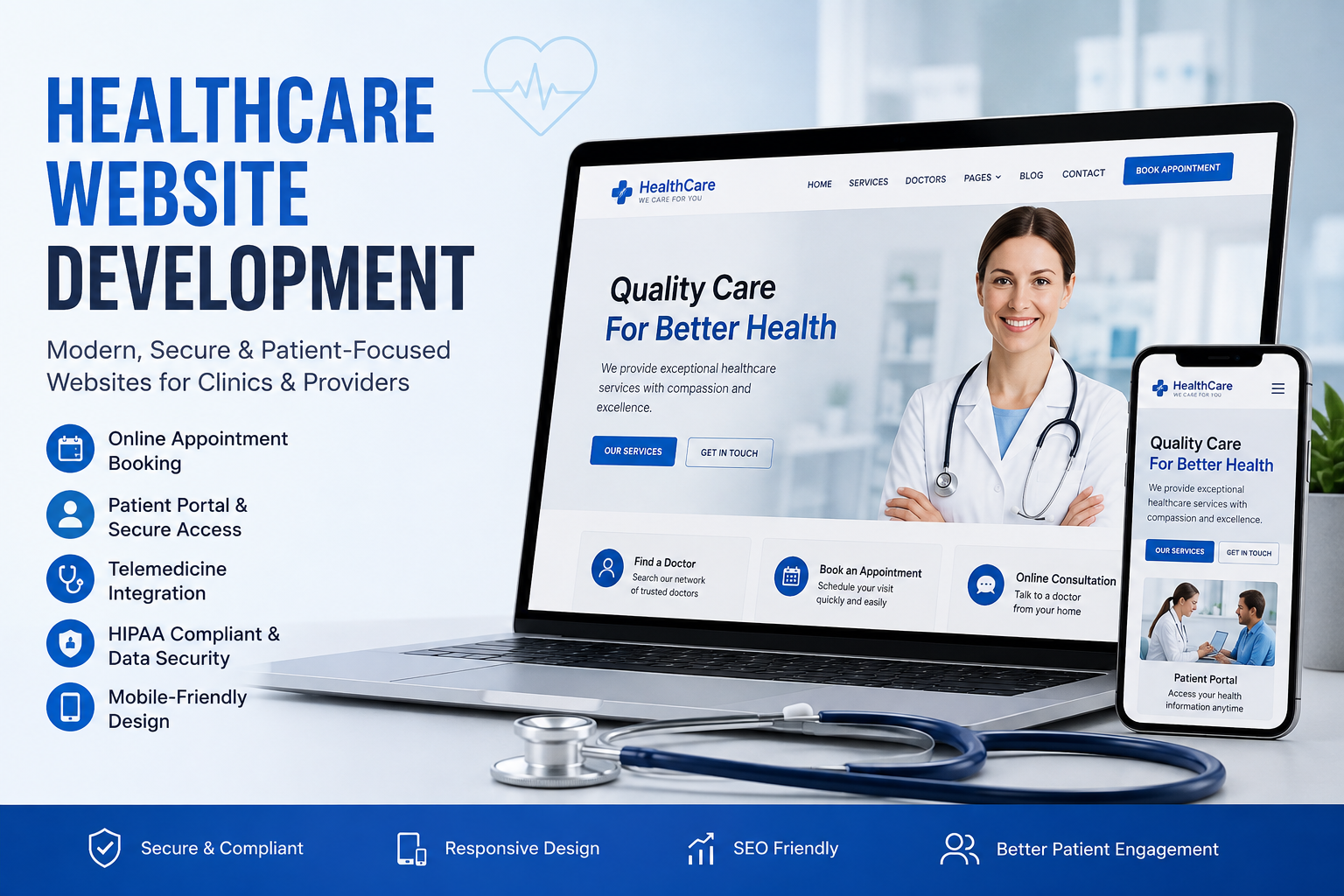
A solid healthcare website development project usually includes:
- Online appointment booking — reduces phone calls and no-shows
- Patient portals — secure login for health history, records, and direct provider messaging
- Telemedicine integration — video consultation tools and virtual queue management
- Provider/doctor profiles — with credentials, specialties, and photos
- Service pages — one dedicated page per treatment or department
- Location & hours — with embedded map and click-to-call
- Patient forms — intake forms available for download or secure submission
- Reviews and testimonials — social proof is a major trust driver in healthcare
- Mobile-first design — most patients search from their phones
- Fast load speed — slow sites drive anxious patients away quickly
The Healthcare Website Development Process
Overall, building a compliant, patient-ready website usually follows four stages:
- Planning & scope — map out target patients, services offered, and required clinical workflows (booking, intake, telehealth)
- UI/UX design — accessible, simple layouts that work for all age groups, including older patients
- Secure development — built on scalable frameworks with encrypted databases and HIPAA/GDPR-compliant data handling
- Testing & launch — checks on mobile speed, third-party integrations (EHR, payments, booking), and data security before going live
Healthcare Website Cost Breakdown
| Website Type | Typical Cost Range | Best For |
|---|---|---|
| Basic single-page site | $1,500 – $3,000 | Solo practitioners, small clinics |
| Multi-page site with booking | $3,000 – $7,000 | Established practices, dental/med spas |
| Multi-location site | $7,000 – $15,000+ | Hospital groups, franchise clinics |
| Custom portal/EHR integration | $15,000+ | Large healthcare networks |
Compliance and Data Privacy
For US-based practices, healthcare website development must account for HIPAA. Specifically, this applies whenever the site handles patient data — through contact forms, patient portals, or appointment requests.
Similarly, UK practices should factor in GDPR requirements around consent and data storage instead. Either way, a secure hosting environment, SSL encryption, and privacy-compliant form tools are non-negotiable, not optional polish.
SEO for Healthcare Websites
First, once the site is built, it needs to actually get found. Indeed, local SEO is especially important for clinics, since most patients search for care near them. So, key steps include:
- Optimizing the Google Business Profile alongside the website
- Creating individual, keyword-targeted pages for each service and condition treated
- Building location-specific landing pages for multi-branch practices
- Earning backlinks from medical directories and local business listings
In addition, explore our Medical Website Design Services to learn how we build SEO-friendly healthcare websites for clinics and healthcare providers.
Design Choices That Build Patient Trust
Design in healthcare isn’t just aesthetics — it directly affects conversion. For instance, clean layouts, calming color palettes (soft blues, greens, whites), and real photos of the clinic and staff perform far better than stock imagery.
Additionally, clear calls-to-action like “Book an Appointment” or “Call Now” should appear on every page, not just the homepage.
Common Mistakes to Avoid
- Overloading the homepage with text instead of guiding patients to book
- Skipping mobile optimization
- Using stock photos instead of real staff and facility images
- No clear appointment or contact path above the fold
- Ignoring page speed, which hurts both SEO and patient experience
FAQs
How much does healthcare website development cost? Generally, a basic clinic site can start around $1,500–$3,000. Meanwhile, a multi-location practice with booking and patient portals can run $10,000+.
How long does it take to build a healthcare website? Generally, most clinic websites take 4–8 weeks, depending on page count, integrations, and content readiness.
Do I need a HIPAA-compliant website? Yes, if the site collects any patient data through forms, chat, or a portal. Likewise, UK practices need GDPR compliance instead.
Can I add online appointment booking later? Yes, but ideally, planning for it upfront avoids a costly rebuild of the site structure and hosting later.
What platform is best for a healthcare website? WordPress is common for flexibility and SEO. However, the right choice depends on the booking/EHR integrations needed.
Do I need separate pages for each service? Yes — in general, dedicated service pages perform far better for local SEO than one combined “services” page.
How important is mobile design for healthcare sites? Very — after all, most patients search and book from their phones, often urgently.
Should I include patient testimonials? Yes, since reviews and testimonials are one of the strongest trust signals in healthcare marketing.
What’s the biggest mistake clinics make with their website? Above all, no clear call-to-action. Patients should be able to book or call within seconds on any page.
How often should a healthcare website be updated? Ideally, content and provider info should be reviewed quarterly. Meanwhile, a full redesign every 3–4 years is typical.
Can a healthcare website integrate with my EHR system? Many can, depending on the EHR. Even so, this should be confirmed with your developer during planning.
Final Thoughts
Ultimately, effective healthcare website development combines clean design, patient-first usability, strong local SEO, and proper data compliance. So, done right, it turns your website into a steady source of new patients rather than just a digital brochure.
So, if you’re planning a new clinic website or redesigning an outdated one, working with a team that understands healthcare-specific requirements makes a real difference. That’s exactly the kind of work Web Dream Agency specializes in — helping clinics and healthcare providers turn their website into a real growth channel.